Dir: John Ford
In a banner year for Hollywood (in which Ford also directed Stagecoach), it would be a tough decision to pick out any film and say it was the best. Now, I can't claim to have seen all of the films that are championed as "masterpieces" from 1939, but having seen this and Howard Hawks' Only Angels Have Wings, I can certainly say that it was one of the best years ever in all of cinema. Ford combined a highly fictionalized account of young lawyer Abraham Lincoln around a courtroom dramedy (that is always a terrible sounding portmanteau, but apt here because there are some serious gut-busters during the trial). Henry Fonda is again a perfect Ford lead (this was their first collaboration), prone to long pauses and seeming introspection in a type of film that usually would shun such cerebral behavior.

The "Honest Abe" myth is in full swing, and that hokey-ness might be too much for some people, but it really worked for me. It's hard to explain, but I think that because the film felt dated actually made it seem all the more brilliant. Ford really gets into Abe, and despite the fact that he always wins at whatever he does (like a log-splitting contest), there are some truly incredible moments, like Abe being unable to pick which pie is best as a judge in the "Best Pie" contest because they are both "too good", or his book reading postures in general, in which he tangles himself up, sometimes to the point where he reading upside down.

I think if you really want to think about Ford's as a visual artist, one just has to notice where he places his characters: they are just in very beautiful (albeit sometimes artificial) locations. Abe's early love interest in Anne Rutlege is beautifully shot as they walk along a river. Abe has to deal with many rivals (including Stephen Douglas) once he meets Mary Todd in Springfield, but even then Fonda plays Abe as a man with a penchant for being reluctant. It's clear that his take on Lincoln is that he was a weird guy with a moral streak, and these odd touches make it all the better. The best of these "weird poetry" scenes is when Mary asks Abe to talk outside after a dance, and then Abe proceeds to stand on the balcony, leaning against the railing as Mary sits down. Then he just stares into the darkness for almost a minute as Mary watches him before the scene fades out. Being that you read my reviews, you know that I tend to get hyperbolic when I have strong feelings either way on a film, but God damn: John Ford was a genius.

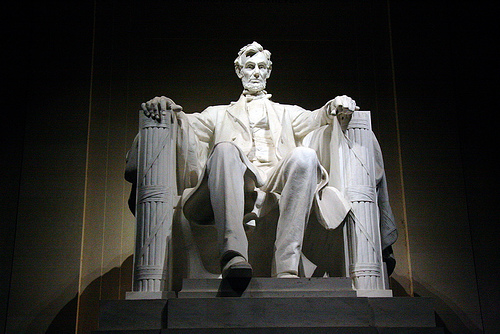
There are many great things in this, but the one thing that really pushed me over the edge was the way Fonda played Lincoln in court, which contrasted well with the prosecution, who were presented as dandy law-men. Not only does his "every-man" logic and wit win over the jury, judge and crowd, but his eccentric movements and postures (slouching really) are just plain out there, to at one point where he just sits down on the floor. His slouch comes into play during one of the prosecution lawyer's bombastic ravings, where Lincoln is staring off into space in the same position as the Lincoln Memorial (maybe a bit more slouched), but I think I seriously went "Oh, wow" to the empty room. It's so obvious, but right then I thought it was the most brilliant thing ever.

While most of the plot is downright mythological, it proceeds in a very natural way under Ford’s elegant direction. Perhaps one of his single greatest strengths is his ability to avoid the cinematic principles that trapped so many Hollywood productions from this time period. There is some slightly too expressive musical pieces, but for the most part they seem present to underscore the very poetic intentions as opposed to manipulating one’s feelings. The initial poetic poignancy displayed in the opening sequences is ditched once the courtroom scenario starts, and while this shift in tone is somewhat disappointing, it doesn’t really ruin the film at all (as stated above). The end is definitely over-the-top, where after Abe wraps up his trial and sees the family safely off, he walks off into a storm (which would have been beyond genius), but then it fades into a painting of the Lincoln Memorial with the pomp of the Battle Hymn of the Republic blaring. In the context of the film, it still kind of works, but it seems like the sort of thing that Ford might not have had full control over. Either way, this is a bona fied masterpiece, with all of the great things about Ford in full effect.